Design
With an innovative and future-proof design, MultiLab is set to become a booming and diverse area.
Below, you can find the details of our MultiLab concepts and design decisions.
"A space that brings together different layers of society, while maintaining the Strijp-S image"
BLURRING THE BOUNDARIES
.jpg)
The area of Stijp-S knows a lot of creation. First the creation of Philips lightbulbs and thereby the first build-ings on Strijp-S. Second, the creation changed to renovating those buildings and innovations. At the moment, the third evolution is going on. The area is creating new buildings and new functions are added. This creation should be going to keep the area innovating
EVOLUTION OF CREATION
.jpg)
The area of Stijp-S knows a lot of creation. First the creation of Philips lightbulbs and thereby the first build-ings on Strijp-S. Second, the creation changed to renovating those buildings and innovations. At the moment, the third evolution is going on. The area is creating new buildings and new functions are added. This creation should be going to keep the area innovating
INDUSTRIAL ATMOSPHERE
.jpg)
The impression of Strijp-S is giving a colossal industrial feeling, the major ren-ovation kept the industrial vibe but gives also an up-grade to the area. Further-more it feels free to be yourself and not suppressed by society's stress. The area is more open to creativity, greenery, and culture. To keep this clear atmosphere in Strijp-S, the same feeling should be followed.
Background
Location
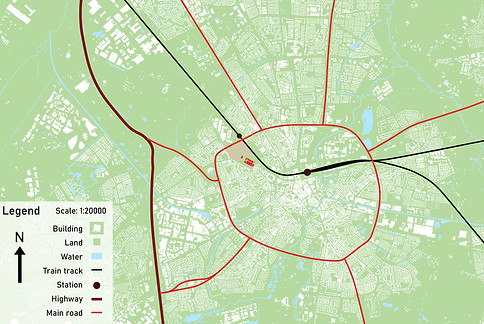
Eindhoven is a city which is located in the province of North Brabant, the Netherlands. It is the biggest city in the province and fifth biggest city in the country. The city is known to be the major technology hub of the Netherlands and a home to Philips, one of the largest electronics companies in the world.
The Strijp-S, where our project takes place, is a neighborhood in Eindhoven. It used to belong to Philips and some industrial heritages, such as former factory buildings, remain on site. Today, the neighborhood is known as a “Creative district" where young creative artists and companies are gathered.
Accessibility
Strijp-S is centrally located, near the city centre and Eindhoven Airport. Close to the A2 highway, Strijp-S is a very attractive location for car users. However, public transport is also well-developed, with an own train station and a high-frequency bus line. Trains run directly to ‘s-Hertogenbosch and Tilburg, and Eindhoven Centraal is also relatively close by, offering services to the Randstad and Limburg.
.jpg)
Site analysis, functions
The surrounding of the Microlab building is a concentration of an office function. The interactive functions such as restaurants and retails are only present in the northern-west part of the Strijp-S, and the Microlab area seem to lack these functions.

Urban plan
Urban Plan

The urban design aims to improve the area with the three overall themes of the project in mind: Blurring the Boundaries, Evolution of Creation and Industrial Atmosphere.
As the main theme for our design, the urban plan has been designed with the concept of a blurred environment, both physically and functionally, in mind. The area blends greenery and paved areas by creating strips of greenery. The original pipe connection of Microlab, the Leidingstraat, is kept in order to preserve the industrial heritage.
Functionally, the area is transformed from an office-only area to a vibrant multifunctional area with retail markets, restaurants, cafés and residences. An atelier, where people from all generations can engage in arts projects, is one of the highlights of the area. Not only functionally, but also socially, boundaries are blurred.
The parking lots contain so-called ‘turf grid’, which is a combination of pavement and green patches. These surfaces are placed in order to reduce the heat effect in the area.
Urban elevation

Mobility plan
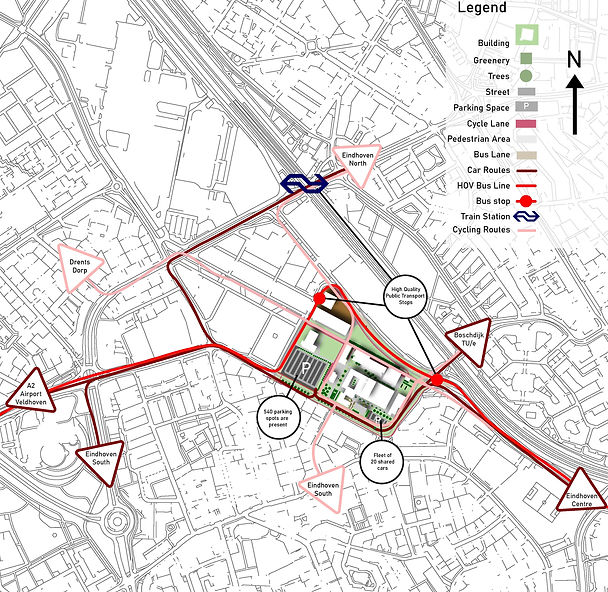
In the redevelopment plan, the Microlab area makes use of current infrastructure, which is already well-developed, both for automobiles and public transport. The area itself is made car-free. Visitors and residents can park their car in one of the parking spaces, with a total capacity of 550 parking spots. A shared car system is also available, of which residents and visitors alike can make use.
Architecture

The design
The building has been design with the vision and themes in mind. Multiple large new volumes have been added to the exiting Microlab, creating a completely new atmosphere in the area, aiming to add a new liveliness to the Microlab area.
The existing Leidingstraat leads visitors to the large atrium that acts as an connection between the buildings. The existing industrial style can be found in the facades. Mostly present in the used of depth in the facade. Wood is the main facade material. Showing the evolution humanity has gone through over the years regarding the importance of sustainability, which has been an important in the design of MultiLab.
On the floorplan the layout of the ground floor can be found. This floor houses the public functions that can be found in the building, such as the market, the atelier and the cafe. Acting as a meeting space for people from surrounding areas.
Moreover, the ground floor of the residential buildings can be seen. In total these buildings contain 52 social housing dwellings and 16 student dwellings.
Besides the dwellings located in the L-shaped buildings there are also dwellings designed on top of the existing Mircolab. In this extention six luxery apartments and 22 middle-income dwellings are realised.
MultiLab provides dwellings for a large range of society.


Ground floor
Fourth floor
Elevation

Section
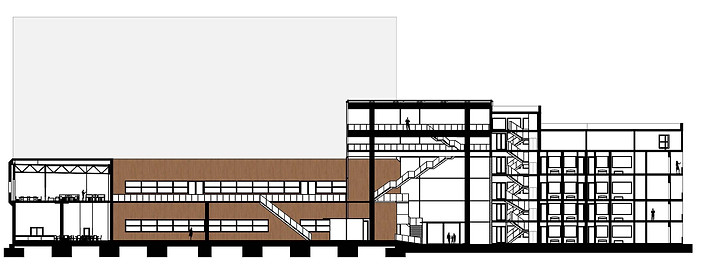
One of the key aspects of the MultiLab design is the enormous atrium. This atrium functions as a entrance to the MultiLab area, but can also be used to enter the apartments located above.
The atrium connects to the evolution of creation as it will be used as a exhibition space. Forming the connecting element between the creators of the MultiLab and the Microlab.

The boulevard leading visitor to the inviting atrium.
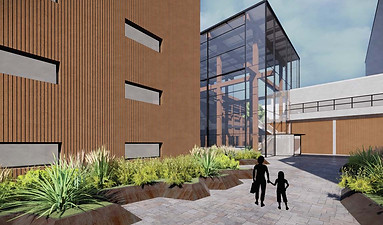
The atrium is constructed by a large wooden structure, showing the importance of sustainable material choices in the design.

Large staircases lead visitors to the apartments in the extention on top of the existing Microlab.

The courtyard created contains a great terrace where visitors from the market hall can have a seat. The trees in the middle prevent visitors from directly looking into the private area on top of the market hall.
Structural Design

3D Axonometric drawing
The proposed design offers a way for the volume built in an industrial time largely from steel and concrete, which is the current Microlab, to be opened up and integrated into a larger, more eco-conscious plan directly portraying the transformation the area of Strijp S has undergone.
Detail
This urban timber system is built form a combination of glue-laminated and cross laminated timber elements. With not only the constraints of the site, but furthermore the ever-pressing necessity for the built environment to reduce its carbon footprint, timber elements were chosen for their high strength to weight and, when sourced correctly, sustainable qualities.
Real Estate

Cost calculation
The feasibility of the redevelopment project was calculated by gross initial yield. It is calculated for each building and each function based on initial investment costs and expected revenues on the first year. Also, the feasibility of the total project is calculated by Discounted Cash Flows methods in 30 years. The final result of the DCF is approximately 14.8million euros.
Stakeholders
The multi-lab is owned by 3 building owners. 2 independent buildings occupied by affordable housings are owned by a housing association such as Trudo. The Microlab building and its addition are owned by two parties. The first party is the luxury apartment owners who are also the residents. The luxury rooms are sold directly to the owners by the developer, and this helps the developer to gain some investments back in the first year. The second party is the commercial real estate investor such as a.s.r.real estate. They are investors for the commercial functions including office, atelier, market hall and middle income housings. The middle income housings, which has steady demand in the market, compensate for the relatively high risk of other commercial spaces.


Building physics and Systems

System Target
An integral part of the redevelopment of the Microlab area is to make the new building future-proof by installing systems that make the building self-sufficient in energy production. This is an important aspect in designing a building as of today, with global warming and polar ice caps melting as pressing issues. Since Strijp-S is an area of innovation, this fits perfectly with the new way of designing. Conscious planning of energy producing systems and demand reducing systems makes sure that our design is energy neutral within 30 years. In this section, the climate neutrality and the systems used are explained more in detail.
Climate Neutrality
As mentioned before, the building aims to be climate neutral in 30 years, so before 2050. Making such a big design required a lot of energy to be produced to make sure it can reach this goal. But by installing systems that provide the building with energy on all roofs and in the urban area, and by using sustainable materials, we were able to design a building that is climate neutral by 2049, reaching the goal set.
Systems
For reaching this goal, some important systems were implemented in this design, namely:
-
Solar panels for solar energy production
-
Wind turbines for wind energy production
-
Aquifer thermal energy storage (ATES) to reduce the heating demand

Wind turbines
-
Located on the roof of the L-shaped buildings
-
Solar panels located above it
-
Yearly produced energy: 5.305 kWh/turbine
-
Embodied energy: 9.183 kWh/turbine
Solar panels
-
Located on all roofs
-
Integrated in glass of the atrium
-
Integrated in the urban design
-
Yearly produced energy: 220 kWh/m2a
-
Embodied energy: 976 kWh/m2a
ATES
-
Provides the total heating demand
-
COP: 4
-
Saves about 60% of the total demand
-
Embodied energy: 414 kWh/m2